MCAC
Robot Baristas Meet AI Meeting Takeover
Comments
Loading polls...
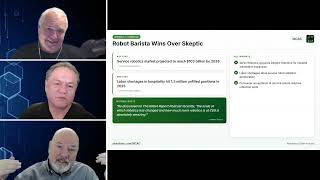
“"Service robotics has long been the 'next big thing' that never quite arrived - but something fundamental is shifting"”
“"At the end of the Tesla ride, it asked for a tip and I clicked the higher amount - then it said 'just kidding' - it was hilarious"”
“"We are the #1 sub-billionaire podcast - most other podcasts are run by billionaires, but we're the perspective of the sub-billionaire like most of us"”
Listen to this episode
Fact Slides (6)
Clips & Shorts (3)

View Full Transcript
This is your captain speaking. This is time I'll play as your best air seat belts. 25G style. My weight ain't here. You'll be able to take a bite. Oh. Good morning, guys. Hey, it's recording day again. And here we are. We are having so much fun. We are the sub billionaire podcast. Now a lot of other podcasts you go on, we like other podcasts, but sometimes they're billionaires. And we are the perspective of the sub billionaire. Like most of us, we're sub billionaire. So here, the number one sub billionaire podcast in the universe. And we are getting started today with what? Ah, our barista. We all have a favorite barista. You know, when you go in and they smile at you and comment on something or you can just see that they are positive. And so I wonder who are these people? And how do they stay so positive all the time? You know, are they crying on the inside and they go into the bathroom and give themselves a pep talk before they start serving the public? Who knows? Whatever it is. But you go in and you talk to your barista and you always feel better. And then they put some sort of little design on the top of your latte, right? And it's like there are teests and they do a lot of good things for us. So what happened when we look at the future and the baristas become... But? Yeah, they become robots. Yeah. And I prefer that. Do you? Because you really don't want to get emotionally involved with some beautiful baristas. I don't like baristas. I don't like baristas. You know? No, they speak a different language. Grande means medium or something. I go, I don't speak of the language. And a tall is like the smallest one, isn't that funny? I don't get it. Yeah. Anyway, you're starting to happen, right? It's starting to happen. You're going to have a mixologist. The bartenders are also going to be a... And I think that bar owners are going to really like that. Even if they have somebody working behind the counter as a barista or a bartender, they're going to allocate the expense of the alcohol to precision, right? Yeah, I'll be honest with you. You know, service robots have been around the idea of having them in the future has been around as long as flying cars. And we still don't have those either. But anyhow, so these ideas of now putting service robots, doing some common tasks like these... Yeah, that's something that's now just starting to really get into the public view now. So this article that we saw on the news about a reporter who said, I'm going to go check it out and see how real this is. And he's found out that actually it was pretty good. You guys remember that movie, a 2017 movie called Passengers? It starred Chris Pratt and Jennifer Lawrence. And there was a robot bartender, not a barista, but a bartender named Arthur. And he played... He was played by Michael Scheme. Anyhow, this bartender is a central character in that movie, right? And he gives advice to the humans that come to the bar. So I could see AI eventually doing that. People are getting advice right now from AI. All kinds of advice. Met a person who really just asked your bartender who won the 47 World Series or whatever. Yeah, I can see that working out. They have opinions and they actually get pretty good advice. I've even asked AI a bunch of things that came back with some pretty good ways to get my thoughts in order. Let me think in the right direction. It didn't say I needed to do anything specifically, but here's the different avenues of thought you should probably do. And when we took a... We took a crude royal Caribbean cruise and it had robotic bartenders on there too of them. But now there were robots. They weren't very... They were like a humanoid type of things, but there were just little arms that did all this. But man, those things were fast. They could mix and drink really quick. Now, I don't drink. I could... I appreciate it. They did make milkshake. So it... It was cool. So we see that starting to happen. So anyway, service robots really are the future for everything. What is... This is my domain, guy, right? I spent literally all my life bartending, running bars, running nightclubs and things like this. And I like the barista in the coffee shop because I don't really come much care for the coffee shop. But you're messing with my livelihood there. And I think that the bartenders are very important. All the nice thing Bill said about the barista? I say that what about the bartender? Be cool. Like I said, you could ask who won the 47 World Series and have this encyclopedia behind the bar. But I think he loses a human touch. Yeah, that's true. So a good friend of mine, James Azar, he runs a podcast and it's called CyberHub podcast. He starts every day and he shows a machine that's creating an espresso. And then the first thing he does is coffee cup cheers. What is that? Coffee shop. And James Azar does the CyberHub podcast every day. And so if you turn, tune into it, it starts it, I think nine o'clock Eastern. So that's what eight o'clock my time. There you go. Coffee cup cheers. There are more than just the baristas involved, right? There's the machines that create it for you. But then there's a social of coffee cup cheers of being friendly and inviting each other to celebrate something like the Europeans are so good at celebrating everything. Of course, they brought us the espresso machines and the espresso and that sort of thing. Anyway, so anyway, yeah. So we, I think we all have mixed feelings about our human world that is starting to change to some degree. I don't think that they're going to replace people. They're going to enhance by not making the people do all the menial work, right? To figure out the mix and that sort of thing. It's just going to come out. And that's going to give the barista or the bartender more time, more energy to focus on their psychology of improving people's days in order to get what? That tip. And of course, we all remember, are you supposed to tip something that's autonomous like that? Now, last week when we took that ride in the Tesla, at the end of the ride, it came up just an Uber would and says, Hey, how are you going to tip earnest here? And I looked at that and I said, this is dubious. So there was two amounts. There was one that was a very low amount and another one that was a relatively regular tip for a Uber ride or something. And so I clicked on the higher number and what happened? It came back and it said, Oh, just kidding because it got so hilarious. It was like, Oh my God. So the barista, I believe, is still going to be there to get the tip, to enhance our lives, to take it from the machine and put it in front of you, ask if there's anything else or if it needs to be redone or anything of that nature. I don't believe we're looking at a world where we're going to be interfacing all day long with machines. Yeah, that's a great point. If you look at it that way, back in one of the night clubs that I was bartending at, what we did is we had a special bar that was just for comedians. And you guys all know Tom Arnold, married to Rose Ambar. He and other local Minneapolis comedians would, we just had a shot bar so they didn't have to have any talent. But you could then focus the same sort of concept, focused by having people with great personalities or maybe it's good looking people or whatever your theme is at the bar. And they're not burdened by the making of the drink. The drink would be much faster. And I'd let the baron robot hand a drink to them. That's what I would do. I'd agree with you now, Bill. Hey, what do you think though about? That's a tough thing, man, to admit that you have been pulled over by my discussion here. Yeah, that was against it. I'm not on for it. But I don't know because the cost on these things, like 100,000 to 300,000. So I'm just guessing a lot of the coffee shop owners and the bar owners are if they even go, I think they'll wait for it to come down and price a little. But if they pull the trigger on that, they're also going to pay some joke or 25 bucks an hour to fan behind that. I don't know. Well, that Joker can be the personality that the AI can have. And a few weeks, I go to Toastmasters. And that Toastmasters is always what's called the joke master. And the joke master gets up during the meeting. Toastmasters international is a place where you go to learn how to speak, to practice your craft, and to get better. So I go, my wife and I both go and we go to Toastmasters. And there's a role of the joke master. The joke master gets up and starts talking about various jokes. Of course, you heard them all dad, I usually do dad jokes if I'm the joke master. But oftentimes I use AI to help me find my content. And then I perform as a human, but I use material that the AI has helped me find and curate. So this podcast, you guys all know that we have an AI system that helps us analyze all the current topics of the day. And one of the things that we do in order to get muscle memory around bantering back and forth between each other is we do these mock podcasts. And we have it, with 11 labs and it uses Bill Jim and Gus's voice. And then it takes and builds like a little five minute mock podcast on each one of the topics that we're delivering today here. This is one of them. And we listen to that as a way to build muscle memory to get better at talking and the AI gives us some good material. And it's actually pretty funny. And believe it or not, the AI at 11 labs will even make you like it does it in my voice, Jim's voice and Gus voice. And when Gus laughs, it's a laugh in his voice and it's a chuckle or what have you. So the technology is getting pretty, pretty good. And when I listen to those, I chuckle a little bit myself. I think we're moving into a world where baristas or other frontline service people are going to be enhanced by AI. Watch television. You watch television and it's the old, what is it when you watch the Senate and the C span? How boring were those things always? It's not going to be like that. Why? Because the politicians don't have any content. It's funny. But we do and we can use that content and it enhances our lives and people who wouldn't listen now listen. So we use it on our podcast, not to basically do the work, not to do all the speaking, but to help us learn how to be better podcasters and use the material that's funny and it mocks. Yeah. Can we just act like we're smart? Why do you have to give all the secrets up? In the shaper. Now they're going, God, they practice with all these vodka and they're still stuck. This is all in the news because things are progressing toward the rising cost, labor cost, hiring people to do things. The falling costs now and the robot cost, right? Those prices are coming down and it's going to be rena robot. I know you raised the thing $100,000, but it's not going to be that way. It's going to be, hey, we'll put this in your facility for X dollars and about this cheaper than what you're paying these people. So here you go. Boom. Yeah. When it hits that point, when it hits that point, it's even before that gem because you know right now in the service industry, there's a shortage of, there's a lack of qualified people because they just started doing other stuff. The study has changed a lot. People, you did not as young people. All of us, we probably have jobs when we're really young, really young, probably during summer's while you're in high school, not happening in this generation. They are happy to just live off their parents so they don't get the social experience. They don't learn how to work in a service industry. A lot of things like that they should have learned. So it's not only the fact that we're going to lose, that's for sure we have lost that. And maybe that's parents that just basically want to give their kids everything. But here's another upside of using robots is that there's predictable up time, right? Okay. So a human gets sick. Oh, I'm out with the flu for three days. I'm going to happen with a robot consistent output because once it's been programmed, it's going to do it. Can it mix drinks faster than a human? Yeah, 30 times faster. So you're on to retrain a new person every few months. Look at our world. Look at our world and what's happening today. You buy autonomous cars and they're talking about putting induction charging in your garage. So you just pull into your garage. The induction charging starts working. You don't have to plug it in. You don't have to do anything. Now when I was a kid, I was like 15 years old. I was working at a gas station and I was fueling people up. By the way, I just want you to know I was selling gas for 19 cents a gallon in Orange, California, down in Southern California when I was a kid. And yeah, it's so what's happened. You don't even have self. You don't eat now everything's self service. Man, when I would sell gas for 19 cents a gallon, I would check their oil. I would check their radiator. I would check their windows. I would wash their windows. I would air all their tires for 19 cents a gallon. And it was, I learned how to be a service person in Germany. I actually worked as bus boys at holiday in in Monterey, California when we were 16 years old. We competed on how exemplary, how well we could serve other people always knowing you always take things away on the right hand side of a person. Now you go and it's like you're lucky of the waiter or waitress throws the dog on plates on the table. Don't care. And then put the hand out and they make you do half the work. Who gets this and who gets that? No, I know. I agree. We don't educate people. They don't know how to serve. They don't know any of these things. And those were arts. And it was a thing that we were very proud of. Jim was better than me. There's that skepticism around our robotics going to replace humans. No, they're not going to replace humans. Humans will move into a management role. So our jobs will actually get better in a sense that like Bill said, the lominial work break gets done by robotics and that kind of thing. But just like smartphones, people remember Billy and I had these big old bricks that we carried around. We were the first adopters of these smartphones. They weren't smartphones then. They were just just portable phones. Self phones. They were cell phones. Generations were different. But they were brick. They look like a regular princess. They look like a princess phone on a brick. Yeah, they're huge. They weren't smart at all. I'm not old enough. I'm not old enough to remember that Jim. He would have had those. And we were early adopters as in everything. Like I said, we're always early adopters in everything. But I always said my model was by high cell low and I bite the latest technology. I end up getting rid of it for nothing because it's by then it's commonly adopted and worth nothing after that. But yeah, it's just a cloud computing. People are finally going to that and embraced it. And then AI co-pilot's all these kinds of things that are happening now. Yeah, slow adoption, but really I can see Robo. I love the idea of robots. And I told you we had a whole segment on the vacuum cleaners robotic vacuum cleaners. I've got one in my home. My sister watched my this episode of us talking about that about the robot. She's I'm going to get one of those. That sounds really cool. People just we assume people are early adopters of a lot of technology, but they're not. And very small percentage who have those. Yeah. And like I said, last week, that's why I robot when bankrupt, I think. I said last week that in China, 80% for no 90% of believe of Chinese have adopted the idea that AI is going to make their life better in the United States, 30%. So there is a big gap that people are not adopting this technology yet. They will. We're just slow, but when Americans get it, when they figure it out, we go all the way and we win. So that's the goods. Yeah. That leads us to our next topic, which is step finance losing 27 million in a treasury hack. Now, what does treasury mean? Treasury means company funds. So step finance is in the crypto industry and provide services like mint.com for all your crypto assets. So you know how you go to mint.com and it'll look at all your bank accounts, your credit cards, and tell you all of these different things and you put it into all that and it gives you like a dashboard. Step finance provides a same sort of dashboard, but it's for all your crypto assets. You know, whatever you purchased in crypto coins, if you have, you know, Bitcoin, Ethereum, or Solana or whatever, it gives you this really nice platform. And the finance provides this to people free of charge. Well, there is they're going to use that platform and then they're going to buy some things. They're going to pay for some podcast. They're going to pay for some things and then they make money. So what got stolen in step finance was not people's money invested in crypto. So it wasn't a deal where the people got stolen from us. This is based on this from the company and it was the treasury of the company from their profits and from their from investments that were made in them. So they got all their money stolen. Not a good thing. Now Jim, maybe you have some good things that you can talk to us about how this act took place. Yeah, the name Solana got in the news because they are offering dashboard under the Solana trading platform. And what is the Solana trading platform? It's where anything you want to trade on can be converted or tokenized, made into a token. So they call it tokenization. So if you want to own a piece of artwork, you want to own a piece of real estate, you want to own somebody's accounts receivable or just number of things, it gets converted into tokens. And the tokens begin to be sold out and people buy a piece of whatever it is they've got. So it's in the same thing with what happened with step finance. They had tokens in their treasury sitting in their treasury. So it wasn't like cash money, essentially, it wasn't like they rated the bank because they aren't a bank. There was a holding place, a treasury place, the profits from people trade for their services with tokens. So there was a token bank essentially. But it's just like money if you think about it because it represented money. So they were stolen, but now they've got to convert them out somewhere. I always thought about great, they stole those tokens. How did they actually convert them now? So I don't really don't know that part. And I'm not going to jump into it, but I'm trying to get people to understand is on a decentralized finance platform like Salana. That is what they allow people to do is convert things to tokens and trade them. That's what that's all about. So you can swap tokens there, you can lend, you can borrow against crypto there. No, I think that the... I know. The interesting point too is that it wasn't the blockchain that failed. That might not be understood. And Jim, I think you read some interesting points that it seemed like it was an inside job because there's many layers of authentication. And we were talking earlier about that. The general consensus is that it was either an inside job because the requirement of the levels of authorization you have to get through and order to get to the treasury. Very difficult to get there. Now is it possible if you had an APT actor in there that an active persistent threat, APT, I like to define things like that, that is an actor that is in your system for many months before you even get around to even getting structured. It got in very early. They can put all types of different pieces of software that can monitor and look for you typing in passwords and things like that that it could collect over time. And then it's just a matter of waiting until the funds get large enough to be worth the whole. Right? So then they just say, okay, we got in. You're saying they may have been in all along and then they decided waited for enough money to accumulate. And then they... And typically companies don't release the details about how the hack occurred because they just don't want that happening everywhere. Well, they don't want somebody else learning from the hack and doing it to another defy. So yeah, the ugly word is either insider or just the fact that APT actors got in early and they didn't have adequate security place to prevent that. So what does that mean though, with crypto, the biggest force on the crypto value is trust. And when people read about things like this, it scares them. And if you look at what happened to crypto, I'm not saying it's because of this $27 million dollar theft, but it doesn't help. And Salana went down quite a bit. Bitcoin was that record, you're not record lows, but hasn't been that low in a long time, about a half or where it was at six months ago. And it was scary. I owned four different cryptos. XRP was down 17% yesterday. And it was real scary because it just keep going. Because there's no brick and mortar. There's no product. It's just confidence that it will increase. And so then things like this is a major blow to that. Yeah, Salana is down. Obviously, the step value of the step trading token is definitely down quite. But it was never any hell. It was so if you had a lot of it, it wasn't a significant loss, but it wasn't about the people that were using their service. People are still using that service. That money is still going back to step every month. They're still getting paid. So they're going to build up their treasury event again over time. Whether they can recover or not from this event will be short term financing, whatever it's going to take for them to bridge this loss. Right. It's going to take some time to get back. But overall, it was not a hit to the Salana platform or the users that were investing. I said to you earlier, like I said, it's very possible. It will recover over time. Things will be back to normal. Yes, it hurts right now. But it's probably better to stay and wait it out because there's nothing wrong with the Salana platform at all. Yeah. Now this is a good segue for me to mention to everyone. We have created the tech futures index.com. What is it for? It is an index. It is not the raw stock prices. It is an index that is weighted to show the comparison of AI, crypto, quantum, cyber and robotics. And if you go look at techfeatures index.com and we'll show it on the screen here, you go look at that. You can see that very markedly all the crypto stocks, companies that are stock, public price of companies that operate crypto platforms and systems, they've gone down. The cryptocurrency, which we also track has gone down. And if you go look at that, it's pronounced. It's gone down. Now why does tech futures index.com have this? It's so that you can see the relative contrast between industries. Transure. Different. Yeah. Between AI and quantum, between AI and cyber, between AI and robotics. And you can actually go in our system and compare private companies like SpaceX or Anthropic over to other brick and mortar companies and see how they're the pricing of the private companies and the public companies play against one another. And because it's an index, folks, it's not a raw price of a stock. It is a weighted index. And so when you go look at techfeatures index.com, you can see very quickly that, oh, crypto as a whole industry has just gone down as a whole. And then you can go look on the system at the individual cryptos and you can see that they have gone down. So it's a contribution to the whole industry as a whole. So it's pretty cool index. It's not made for investors. It's really made for those of us who aren't investors to understand where the contrasting is between all these industries. So go take a look at that. And I think you'll be really in the know. In addition to our podcast, the techfeatures index.com is a very powerful component. You can just go over and take a look at it and do a snap. You can things are going up and down. It's if you're not in the market yourself and you just want to learn about it. Maybe you want to get into the market. At least you start to see trends and you see how different markets behave. Certainly I can show you a snapshot of Robin Hood where I do my investing and all the stocks are up today. But they were in freefall. Gus knows they were in freefall and people were panicking for them. The tech futures were not trying to show that. We're trying to show you the long term of how the different markets behave. But if you're an investor, obviously you'll have your own dashboard that's going to show what are my stocks doing today. That means something, especially if you're either a day trader or you are someone who watches it close on us because you're basically your retirement in there. You're going to want to know how things are going almost daily. That's a different way to look at it. Like I said, we can show that to you too as well. But anyway, you can learn a lot. When Bill first built the system, we all kind of said, man, that's pretty cool. Then we said, why don't we put a little bit of money in the market and start asking AI to tell us how to invest it. So I did. I took open AI and then Gus, you had taken X, I think. Yeah, yeah. Yeah. And Bill did. Cloud code. So what the idea was is that we were all investing a small fund and then we were going to let AI control the buy and the sales. And then we did the best. And then we did the best. And then we did the best. And then we did the best. And then we did the best. Between is Claude better for this than open AI than Brock. We haven't really measured that extremely well. But you can continue to watch it. We'll see that we'll comment about this. I'm talking about that. Yeah. Bill and I were talking about maybe, and that's Gus too, we were thinking about, we need to build a little software application that actually does what we want to do because the platforms are great. There's a lot of information on the platform, the trading platform, but specific to just what we want to know about our own stocks, it's nicer to have an application that could track it day by day so we can make decisions quickly. How do you go? How are you right? How are you going to minimize it? You got it open all day long. I do. I do. All right. Yeah. I understand. So what do you guys, did you guys hear the news about China releasing the first commercial grade quantum computer? Yeah. Right? You guys are the technical people. What do you think of that? Yeah. Well, it is a stake in the ground and it is China winning on this one component. However, it's not something that can go break our RSA encryption codes because you need a lot more high quality, accurate qubits, a thousand plus of them. And these are much smaller in the dozens or hundreds of qubits and they're not very accurate. But nevertheless, when Benjamin Franklin went out in the rain and got that key to light up, right? Hey, that's where it starts. That's where everything starts. And Watson said, hear me. Can you hear me now? Okay. Those are the moments and China has this moment. Absolutely. And it's a different type of quantum solution that they're using. Atomic based qubits. I don't know that much about that. I wish I was wondering if you understood it. I didn't understand. It's a bit more low powered like Bill was just saying than the than the traditional quantum methods of computing. So this offering is still not like they're going to sell you a computer and you just put it on your desktop or something. It's still a service. They're going to put it in a data center and you're going to buy time on these quantum computers. We are going to have QPUs, quantum processing units. You know how you buy a GPU and you've been dimmed, don't you have a blackwell GPU that you've opted into one of your computers? I do. An Nvidia. Yeah, absolutely. Okay, so you can take a QPU in the future and just buy a QPU card and pop it in quantum processing unit. Now, that's not what these are necessarily. They're not the super advanced qubits that are near zero temperature and all that sort of thing. But these can hold some quantum states 10 times longer than the superconducting. The superconducting ones are the ones that are at absolute zero degrees, which means you have to have a lot of infrastructure to keep those at that. These are things that are at room temperature where you don't have to have all the cooling capacities or not quantum experts per se. We're not physicists. We do keep up with this and we will continue to keep up with this and we'll help you understand what we're able to understand. We think that we are the conduit between the physicists and the experts in the world and the average man. We're all the sub billionaire average men and we are trying to... We asked a bunch of really smart women to join us, but they wouldn't. Our wives said, no, you guys can have that job. So, what do you think of the fact that... So, China has their moment, right? They got to market first. Is that... I should be worried about that from the standpoint of China is investing. The state is investing in this technology, whereas we're squabbling between the different parties. You got half the people saying all this stuff is bad and we shouldn't be... It takes too much energy and we shouldn't be messing with it. And while we're just squabbling amongst ourselves, they took care of business. Yeah, they made a more deployable model of quantum, right? This is about winning markets, right? They need to get the position on the market first. So they can set the governance models, they can set the migration timelines and all of the quantum standards because they're first to market. If they do that and they get enough business, they will become the innovators that tell us how quantum needs to be deployed. And so that's why it's difficult for us to let that continue on. We've got to compete at the level... Our government should be more involved. Absolutely. We're saying we focus so much on the higher end of quantum and to prevent the Q-Day, that's what they call it, right? The day that quantum can break encryption. So everybody's... We got to prevent Q-Day from happening. Yes, okay. In the meantime, can we just use quantum to solve some of life's really good big problems? And so that's what China has focused on and created a usable model that could be put out and be commercialized immediately in the marketplace. So... It's up to us. Yeah, it's up to us. They do we need to catch up? Yes, we do. So while everybody's debating when quantum computers will break Q-Day, China is just starting to sell computers at anybody can order with the purchase order. Boom bang. Ah, what is this? This is like the Russians and Sputnik, right? The first satellite. Here we go again. Yeah. And they basically put a bunch of people in a big cage called Russia and put a gun to their head and say, you either do this or we're going to shoot you. And so they did it, right? And then the United States had to follow suit and JFK said, we're going to go to the moon. So we're going to one up, yeah. So you're not worried about it? No, we don't have to. You look concerned about it. If China becomes the first country to offer practical quantum services at scale, it makes it extremely difficult for us to catch up. Do we have it in us? Of course we do as a country, but always been able to rise to the occasion. Don't forget, don't forget guys that the Chinese are humankind. We are humankind. We are all participating. And if China wins on this or Russia won on that, it spurs human roads and innovation. And it's, hey, I can identify with Chinese. It's like humans, just like you and I. And we are all winning this race globally. The only downside is that I think as a country, we pay more attention to threat modeling and the concerns of what if we, if it gets out of control. I think we have more dedication to that, which slows us down. Whereas other countries like China say, heck with it, we're just going to go after the commercial market. Okay, if there's some fallout from the security side of things, that's so be it. They don't care. We care about those things. And that's what slows us down a lot of times. So that's the defense that I will provide for the United States and the way that we do things compared to where other countries do it. Yeah. And remember that the China's just the first to commercialize it. We have a lot of different systems, but our systems require absolute zero temperature. And so it's not, it's not an apples and apples situation, but they did provide something that you can go issue a purchase order for and snag right now. Now we have never know when they get better, they might not want to export it to us, but I don't know who's going to consume it if we don't. Of the technology too, that isn't the question. It's more about who commercialized it, who got it out to market first. It's not bad at all. It's just, we just took our eyes off of the price for that here in Zed. We're considering the bigger problems. And yet we need to pay it as to the practical use of quantum in any form today. And so they did that. So good host of them. We'll write to address Bill's point, you know, that this is offered as a SaaS. So you that PO that you're talking about just gives you access to their server and they can control that anyway they want. So I don't think they're too worried about it. Neither do I think American business is going to go over and use quantum services on a Chinese computer. So we have to turn around and do it ourselves and we just need to catch up. So yeah, and that's probably said on that thing. I don't know if you want. You got more to talk about. I got to check my notes and see if I have anything else to say. Are there some notes? Do you have some notes on the next segment, guys? I use as I use the good boy. No, I use the services that take notes automatically because it's a real problem given away the secret sauce again. I'm just no, I'm not saying us. I'm saying that it's hit the world. What's happening? Companies like Otter and the one that we use. What's the name of that? Read AI. Read AI. Read AI. Yeah, and they now have the little business card type of thing that will listen live and a lot of people are offended by that. But it's not just listening and regurgitating. This is doing everything for you, organizing, planning next steps and everything. The statistics show that people in business spend some high percentage of time in meetings and most of it never gets documented. Yeah, and there's no feed and there's no action items taken. How do you feel about those things? Does it offend you if somebody pulls out a little thing? You mind if I record this? What's your reaction to that? It used to be hackles, right? But now it's common day, right? But in a negotiation, contract negotiation environment at the round table, probably this is not a good thing. Somebody would say, yeah, but that's how we get the information. But do we establish contractual obligation by saying something verbally in a meeting and then walking away from them, thinking we never wrote it down on a contract? I see the other side of this thing is in certain business applications. Probably you really think hard. Like really hard before you turn that on for that purpose. And then at the same time, maybe it's equal to everyone and somewhere at the beginning you say, we agree that anything's discussed or is not contractual. At least something like that that you have found to the beginning of this. Everything's off the record. Even though we're taking it through this electronic medium, it does not hold up just a little disclaimer with that hold up. Who knows when that's done? It's uncharted territory. There's a risk. There's privacy risks. There's consent risk. A lot of the states have rules with everyone needs to agree to be part of a recording before you go forward. Venn app and it's called just press record and it automatically records and transcribes from my phone. Now it will not record a phone call on my iPhone. But guess what? It also comes with an iWatch app. So if you hit just press record on your iWatch and you're talking on your phone and it's on the speaker phone, your iWatch is going to record just like it would and you're going to record your conversation. There's a lot of ways to defeat the system and there's a whole bunch of laws that have gone into play and every single state has different rules and what they're talking about now because of the advent of all these AI recording systems is you have to have a plurality. Everyone has to universally agree that they're going to accept that everything is being recorded and everyone is going to be the beneficiary. So it's like a mutual non-disclosure. It can't benefit only me. I'm going to record you guys but you don't get the benefit of the recording. No. That's how it says, okay, well, it builds. Bill has to share that back with other people and that's what Read AI allows us to do when I have a meeting and they're set up on a Teams meeting or Zoom meeting and my AI with Read AI records that. It also offers those people the copy of the recording. So it's a mutual thing, right? So that is a much fairer way. They used to be the world was the big corporations got to do everything and you just got screwed. Now everybody gets the benefit of the transcript and of the recording. So it's a better world but it's not. How it's been there in the past is that you always get consent first. You never, before we used to come in with a little tape recorder and set it on the table, everybody immediately said, oh, what's that for? And then you have to ask permission. I'm going to record the meeting. Can I get your consent to do it? Now, now that's not what happens. Your laptop's open. Nobody knows, but you're sitting here recording everything is being said. Unless you get consent to do that, you're violating some laws. Yes. So it's really important and it varies from state to state. It's a moving target. But there's no clear norms yet, right? Because the technology, again, once again, we talk about this every week. The technology is moving at such a rate of speed that the governance doesn't stay up with it. So we're always tailing behind it and always trying to work out the ramifications of some lawsuit because nobody thought about this. It's the same thing as AI. We now enable AI to do all these things and it goes out and find something that no human knew about it. And yet now we need it to tell us. And if it doesn't tell us, then what does that mean? That means that that intelligence is able to hide something from the human race. So all the governance all the way is the issue. We've got to keep that in real time if we can get there. I don't have an answer, obviously, none of us do. But that is the big problem. It isn't the technology. We love the technology, right? We all use everything. We use, we use, we read AI, all these different note-taking things. But if I walk into a major company and have a meeting, I've got to remember that's not a given. I'm not allowed to use that. But that might be changing though because Microsoft with the co-pilot, they automatically record the team's meetings. Now I was just on the team's meeting yesterday. And I don't know if that feature was turned on, but nobody warned me that I was being recorded. So let me tell you where this is happening. When you load teams onto your computer, all of those intrinsic things that it can do, it's covered by that user in terms of service. Absolutely. It's covered. Here's the issue. It's just every time you do business with a major corporation to buy a cell phone or get cell service, there's a ton of fine print that goes along. And somewhere along the line, these big corporations who have trillions of attorneys are able to put into the fine print something that, oh, wow, just because I installed teams or I installed Zoom, I gave permission intrinsically. We all check the box. We check the box and we don't read it. I'll take it this further. It's also now that we have electronically recorded some highly sensitive meetings, possibly in a development environment or in a environment where you have secret information that's being talked about and recorded. That needs to be stored somewhere and it is. And now eventually that becomes another attack surface that has to be guarded. Yeah. Could be all of the dark deep secrets of the company or the thing that keeps them alive is a company because of their technology. And, well, hit information, patent information, various secrets. All of these things are somewhat at risk and we have to work to make sure that we are protecting ourselves in some way. But just, cybersecurity just becomes even more important every time. So you just basically say, okay, well, I'm just not going to divulge things and that, the only way that we can really have security is somewhat like the government security, which I've been working in for 50 years, 40 years. Since I was a child, we had government security. Remember, I told you the IBM selectrikes and the fact that we were worried about the Russians listening to the power line to see what was hyped on the IBM selectrike ball by the immunations from, yeah, all sorts of things that we have been concerned about as far as government security, fair day cages, the tempest sets, chipsets, you know that we designed mill spec chips where there's somewhat of a fair day cage around the chip, the ASIC, so that what's being discussed inside that chip does not emanate out. There's all, it's called source suppression. There's all sorts of capabilities that we have had since I was doing this back in the 80s and we were worried about the Russians listening to our power lines tapping our power line as if they were a regular customer at a residence and then they can listen to the emanations and figure out where typing secrets on our IBM selectrike typewriter. So we put power conditioners in to filter and to keep that and we put out all of our computers in a fair day cage so nobody see the emanations and then all those sort of things and then we build firewalls and then we segment and air gap our networks. All of these things come into understanding and some of us who have been working in these things it's like, yeah, sure, of course we have these capabilities. Like I said, you install some piece of software like Zoom or Teams and there is somewhere in there some statement that holds harmless Microsoft or Zoom from the fact that hey, buyer beware, you need to know what's being recorded and what isn't. Yeah, as we opt all these technologies but we eventually let our guard down. Initially our guard's up, right? People talking about with a little Amazon puck in your house is listening to you all day long. Oh, we we learned to shut off the microphone or something like that. So do we only what we should and we turned it on when we need to use it but turned it off the rest of the time. None of the devices in my house are like that or have the microphone on by default or the camera. How is my wife going to know what the weather is? That's the only thing every morning she asks for what the weather is that listen through us all day for that. I'm not a conspiracy there is at all. I just don't want it telling me what I should buy when I didn't even ask for that and it does pop up. If I leave that if I leave that microphone on the next time I go into Amazon and look something it's popping up stuff. I talked about while that thing was on and it just that is just too spooky for me. I don't like it. And so it's like in the very first segment we talked about this robot and I gave you an example of that movie called Passengers. That robot was the bartender and he was giving advice to people. Now at the same time they were spilling everything out to them the truth about what they have done and in that very plot of the movie not to give it all the way but if you haven't watched it. Well or alert. This is how the truth comes out because of that robot. So remember that he can't tell he can't tell a lie he has to tell the truth. That's a good thing but at the same time you told him something and he turned around and divulged it to someone else. Yeah it's kind of weird. What we need is to go back to the old-fashioned cone of silence that they have and get smart. Yeah I remember. So simple. You got chief and what's the guy's name in agent nine-unite and they got the cone of silence. It's a good memory. Yeah I was talking to somebody on YouTube on YouTube. No Facebook because they were given an assessment of the Grammys and they said how far do how low it's gone. How terrible is God has become just a political. I won't even read about it. I won't even watch that but anyhow the whole thing was is he we weren't even talking about that we were talking about the days of the 60s the 70s. In my case 60s 70s 70s 80s and how great the music was and you didn't hear any of this nonsense and we just love to listen to the music and the musicians and their talent. That's music of all time that's music of all time we live through it. We did a statement on music and AI and we found out that 97% couldn't determine what was AI created but reality that could go away in 10-20 years. Yeah that's true. It's like we're making a book. It's like we're making a book. Next Jim Kerry. Jim Kerry. He's a human and it came out of humanness. Yeah I don't know either. I love that movie. What is it called? Liar Liar where he couldn't tell a lie. Yeah crazy. How about the Grinch and the Grinch. That is a good point. That is a good point. Yeah. Human energy. I don't know. It's about time for us to wrap up. People are probably getting tired of hearing from us so it's just under an hour and if you want to hear more you can just watch another episode. So thanks everybody for tuning in today. Look forward to it in the very near future. Just want to let you not have the 84 year old AI Renaissance man as a featured offering of the podcast and we'll talk about that and how AI is enabling age people to have self-actualization as they've already reached longevity and now they are being able to self-actualize with the power of AI. So look forward to that. Thanks guys. Any last comments? Yeah you can't forget them. Subscribe. Yeah thanks guys. Always a pleasure.